
Talking about Rural Mission and making connection through Deanery Synod meetings.
I felt it would be time-efficient to ask Deanery Synods if I could come along and have a moment to present on rural mission, and to make connections with clergy and lay leaders who consider their parishes to be rural. So far, Deanery Secretaries have been enthusiastic to welcome me, and I now have a series of Deanery Synod appointments in my calendar. Although I’m charged with rural mission, and I’m focussed on supporting lay and ordained leaders in rural parishes, I think that may be transferability to other contexts.
I have already presented at Durham Dales Deanery Synod, I did this within the first three months of taking on the role – but this is my home Deanery and they were as curious about who I was and what I was doing as much as what I might have learned and been able to offer.
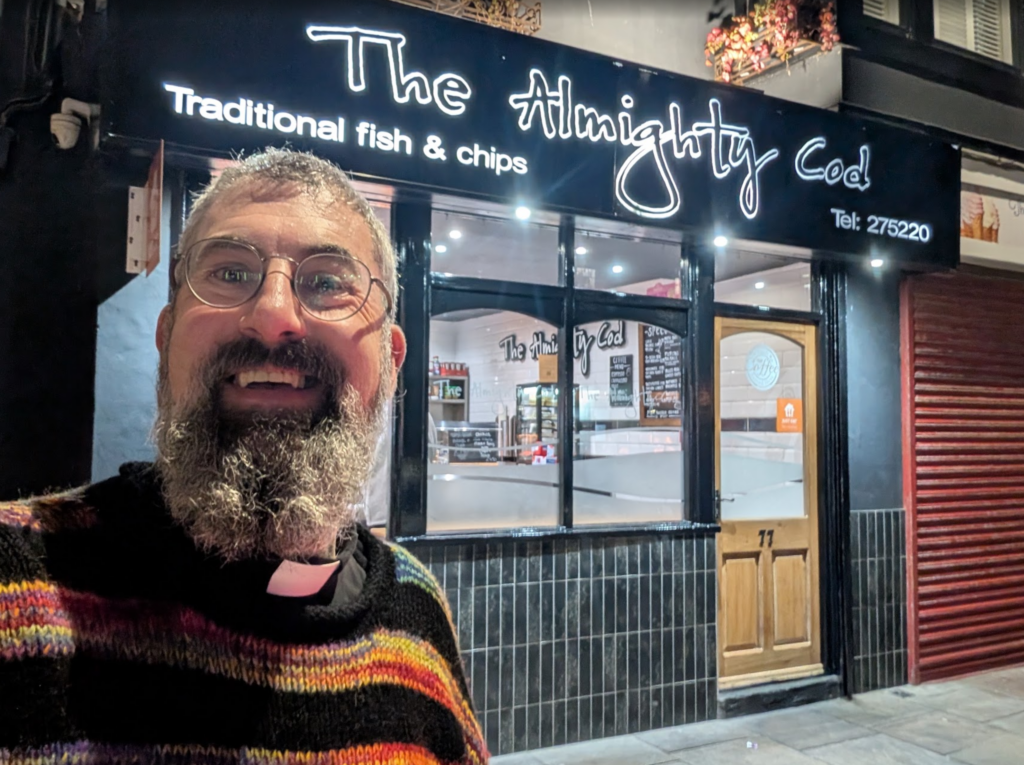
So my first “away” Deanery Synod was to the Hartlepool Deanery, and a November 2026 Deanery Synod in Seaton Carew. I’d had a very busy schedule already, with a Confirmation Course and Joint PCC meeting in my own Benefice, and I wasn’t going to get a meal at home so I headed straight to “The Almighty Cod” on the seafront of Seaton Carew because I know they do fabulously crispy cod and chips.
I was met by a very friendly Deanery Synod and made welcome. Unfortunately the Synod and the Chair had a mammoth task of governance ahead of them this evening, so my time slot was only 15 minutes at the start of the meeting. Nevertheless I hoped to briefly share what we’re doing on rural mission, and make some connections with lay and ordained leaders in rural contexts. Hartlepool Deanery has only one Benefice that considers itself rural, so I’m really pleased to have met the Vicar and exchanged contact details – I’ll follow this up.
I spoke for about 15 minutes on the theological and practical aspects of mission, about the five marks of mission being the outward sign of a missional church, and about “doing what you love, but doing it for God.” I spoke about the things we say by our behaviour and demeanour rather than our words – and wouldn’t it be wonderful if our church mission was joy-filled. Then we had a short but energetic Q&A, and finally the Chair shared Bishop Rick’s prayer and letter on the churches of Durham Diocese becoming “missional churches”. As I left, the Deanery Treasurer said he would have loved for me to be there longer – because he felt there was a lot to discuss and unpack around mission and I had really created a buzz in the room.
Although I’m looking for positives, and I know that with God, nothing is lost – still I felt a 2.5 hour round trip by car to be given only 15 minutes to share about rural mission was disappointing to me, I had expected maybe 30 minutes. I certainly felt frustrated about it by the time I got home.
Archdeacons’ conference on mission in rural and ex-mining villages.
I was given the opportunity to attend the north-east Archdeacons’ conference on mission in rural and ex-mining villages. This was being held in St James, Doncaster. As my Archdeacon wasn’t able to attend, I took notes:
Present: 7 north-east Archdeacons, 1 Bishop, 2 Sheffield Diocese clergy guests, and myself.
Opening worship: Morning Prayer.
Session 1 (10:30 – 12:00) talk by SM – Rector in an ex-mining community:
- SM said, “They are never ex-mining”, they are still referred to as mining villages by those who live there… how long will it take before villages change their mental image?
- Talked about her experience of going to church as a young person and no one ever speaking about Jesus. Ordination was unimaginable for a working class, comprehensive education woman. She spoke of the disengagement between church and community – mission was something done to others, not involving others. No one spoke about Jesus.
- She came to faith in her 40s, after a period of illness – but no one in church at the time helped her faith grow. Church of her youth was about itself and fund-raising for itself. SM’s ministry is formed by a desire to have Jesus at the centre and on the church’s lips.
- SM is changing the way church was when she was growing up, to be more outward looking and Christ-speaking. Sarah spoke of honest openness, dealing with things as they are. Very specifically evangelical in service – e.g. feeding the hungry but in the name of Jesus. Spoke of the ongoing mental health and anger fallout people have that comes from the strikes and political conversation that shut the pits. It is history, but recent, and in mining villages it is very real and present tense.
- She has discovered that people are always happy to be prayed for, will tick the “I am Christian” box ion a census and have an absence of spiritual understanding – there is an uninformed assumption about what church is and what Christianity is. Formed from years of inward looking church that left the spiritual needs unmet.
- SM spoke of ditching service books because people can’t always read or keep up with the service… she has a lively baptism for example: using call and response. She has a growing baptism ministry because she thinks people don’t feel alienated any more.
- Q&A session led to a focus on words such as identity, but also the gap between what was and what is to come… especially education. The church’ response of “loving them” is something that isn’t happening through any other organisation.
- I was struck by the rootedness of SM’s ministry, and the parallels with HR in my Benefice. How do we make routes for people like SM, with no church background (and an HND not a degree), to be ordained in able to minister in their time and place. SM asked how do we move the church from middle class to everybody… how do we raise up locally relevant ministers?
Session 2: (12:15 – 12:45) talk by RF – Love Doncaster initiative:
- Doncaster made a city in 2022. Minster involved in a new initiative 2026-2031 funded by Central Church resources.
- Talked about their vacancies and spoke about the roles that need to be filled, including a funded “Operations Minister”, and the needs demands for children’s work and musical leadership. Spoke about the need for a Parish Nurse – something they hadn’t seen done anywhere else – which made me reflect on the post that had been funded in Teesdale and Weardale. Richard spoke about the “Community Supermarket” which grew post-Covid to provide something outward looking.
- City centre revitalisation and engagement: the church is working closely with the council to celebrate the presence of global majority heritage communities.
- Buildings master plan being developed with experts from the University of York to redevelop the church buildings to be “fit for mission in serving the city”.
- (Note: I’m not sure how this is related to rural and ex-mining, this seemed to be just a talk about revitalising of city church)
Lunch break
Session 3: (1:45 – 2:30):
After lunch I was invited to speak for 20 minutes on my experience of leading mission in rural contexts in our Diocese. After this there was a round table sharing of personal experiences of rural mission from the Archdeacons:
- JI spoke of the spread of rural and ex-mining communities around Doncaster, and the challenge of meeting church needs with declining church buildings and decreasing clergy numbers. He spoke of the difficulty of this, and the struggle to attract clergy to the north and 10 times worse to the rural contexts. The problem of burnt out clergy with multiple parishes and high expectations of church communities for services every Sunday. He spoke of funding applications to interim change ministers (this sounded like projects funded by Church commissioner’s money). Buildings are being closed where there is no ability to maintain them – but Doncaster City Council won’t take the buildings on and the insurance costs of the Diocese holding on to closed buildings is more expensive than active buildings. As a Diocese they are praying for resources from anywhere – and they are seeing some people coming forward to become locally ordained ministers. JI spoke about God being at work unexpectedly.
- BB shared his experiences of ex-mill villages that are entrepreneurial at heart, and of his experience alongside people with disabilities. “If you can’t see someone like yourself doing it, it is difficult to imagine yourself doing it.” BB reflected on SM being a pioneer in the sense of not having followed a role model into ministry but breaking ground herself.
- JT spoke about his journey as parish priest in rural Dales and market towns before being an Archdeacon. He reflected on getting people interested in the gospel imperative and the critical mass of small groups of people proclaiming what is good about their context and church. Spoke about the difference between Benefice priest and Parish priest – you might be the only person who understands the needs of Benefice ministry and what is required / visioned. Everyone knows about parishes… but local clergy are the few who think about the Benefice.
- JT continued about resourcing parishes which create critical mass and thinking about “what’s your treasure” – the thing you as a community would sell everything to buy and treasure. Small things for communities to gather around.
- JT mentioned the Leeds thinking of “Cooperatives” for buildings so that PCCs are able to join a maintenance collective for the economies of scale that come from working with other groups. Talk of safeguarding collectives and other creative hubs that speak of what God is doing – and become better at articulating it. Talked of bringing hope and exploring the Diocese empowering laity through resourcing. Seeing Deanery as a resourcing Deanery, that Deanery Synod is a place which has a value. Also – how do we change Deanery Synod from a lot of people who don’t even go to church and are doing Deanery Synod roles by default – we need to ask the question, “who are the people we really really want at Deanery Synod and how do we encourage and enable them to be there.”
- LH spoke about rural in York Diocese (all of it) feeling unloved because of the urban focus on Middlesbrough and York – and that there are few resources provided for “rural” that are “uniquely rural”. Said that the national church has no value on rural parishes, and reflected back on “finding what God is doing, and joining in.” Rural life is too small to be numerically significant, but is incredibly significant to those who live there. We are also seeing older women who were ordained as local SSM finding themselves stepping up into leadership roles in places where they are known and loved. “Indigenous ministers” was the phrase LH used. Again – finding leaders who may already be there.
- DG spoke about mutual flourishing, and that there is a blossoming number of local ordained SSM older women stepping up to roles.
- CT said it was interesting that there is £multi-million central funding for Love Doncaster projects, but nothing for Sarah in her ex-mining village in Barnsley.
Closing worship: JI led us with a Eucharist service and we closed the meeting.
It was really lovely to be reunited with BB, LH and CT; three Archdeacons who I know and have been very supportive of me at different times in my vocation. It was a delighted to be invited to their conference on mission in rural and ex-mining villages, unfortunately their key-note speaker on rural mission had broken a shoulder and wasn’t able to come. It was nice to be able to speak about my experience in the first 10 months of my Rural Mission Lead role, but I had actually gone along to learn rather than speak – and Doncaster was a long way from Frosterley. These Archdeacon meetings are as much ‘Chapter’ for Archdeacons and they are conferences… this is an opportunity for Archdeacons to come together with colleagues who understand the challenges they share in ministry – so to that extent I was an interloper. I valued hearing the round-table discussion on the rural challenges facing Archdeacons and Diocese from the north-east, but 5 hours driving to a meeting which felt like it didn’t fulfil the purpose was frustrating.
Practical Rural Mission Meeting in a Diocese of Durham Benefice.
I have made appointments with lay and ordained leaders in rural Benefices around Durham, and today I have another parish-level meeting about mission in their specific context. This has been an ongoing exercise since I started but I wanted to make a special blog about this one because it comes straight after the Deanery Synod and Archdeacons’ conference that had both left me frustrated.
…and wow! What a meeting. I was blessed to discover that two churchwardens, a parish safeguarding officer, and the youth minister had set aside time from their day to meet with me and discuss mission in their context. We worked our way through a range of missional topics from how we came to faith, to the good news, to how we might share that faith with those around us. We talked about growth being personal and corporate and the passion inside us to respond in mission – whether proclaiming the gospel, responding to human need or caring for creation. We discussed youth ministry and ministry to the elderly. It was a fabulous 2 hours of personal connection and genuine sharing. I feel privileged to have met with them and been able to offer them spiritual and practical encouragement.
Of the three meeting I have had this week: a Deanery Synod where I felt like a burden, a conference-that-wasn’t-a-conference, and a parish-level practical mission meeting, it was (of course) the practical grass roots level meeting which gave me spiritual food, and buoyed my sense of purpose. I must remember this in the future: I have a Church of England role that grounds me in the parish, and gives me opportunities to offer pastoral, missional, and spiritual leadership insights with people who care about their church and where they live.